What’s happening next?
The family needs to understand where their loved one is going and what the transition will involve.
An independent product concept for exacare ai
Helping families understand what happens next after a referral is accepted.
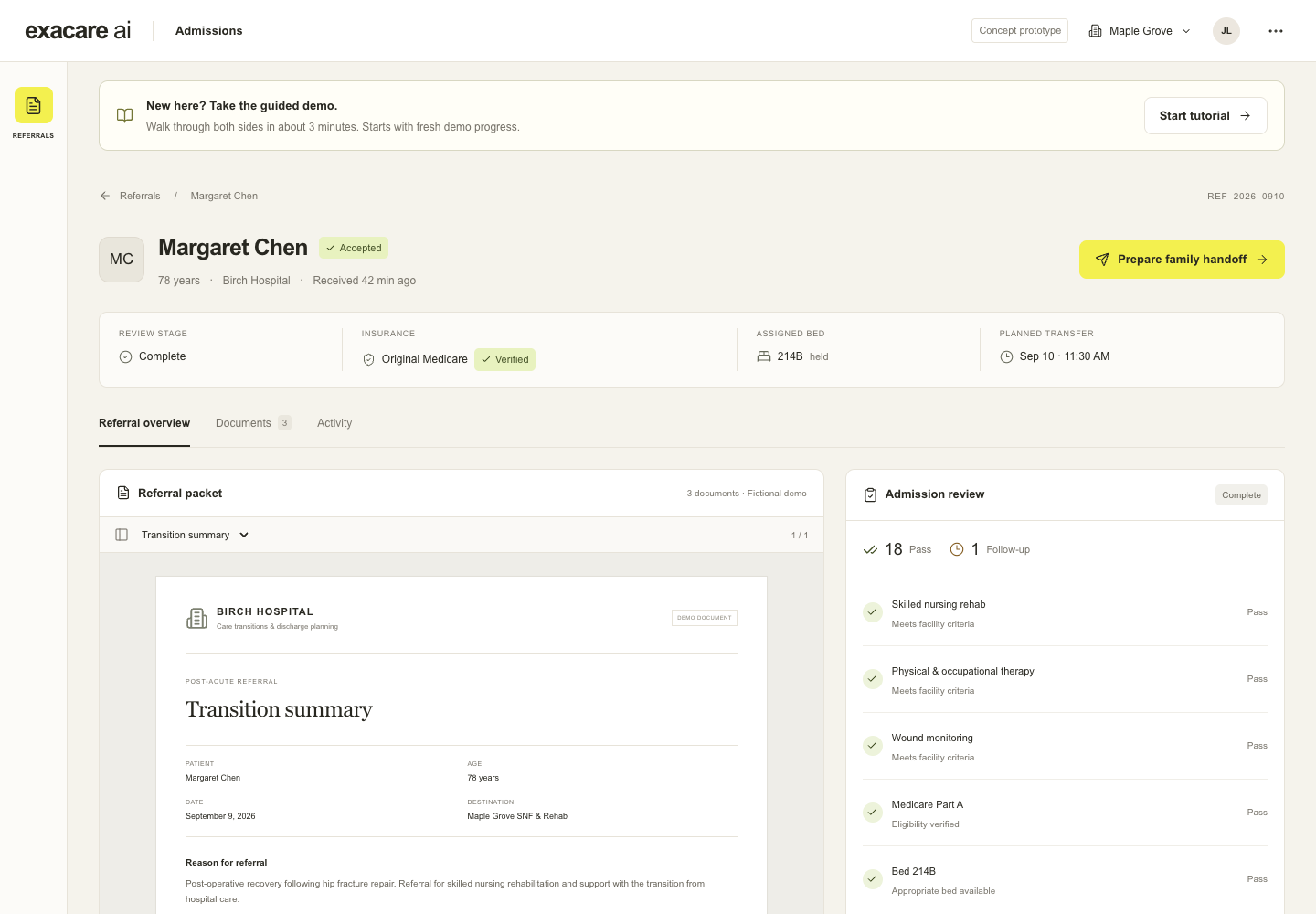
Provider Patient
What if it became
Provider Patient + Family?
A few years ago, my mom had cancer. I was worried about her, but I also remember feeling like I didn’t really know what I was supposed to do. There was a lot of waiting, uncertainty, and activity behind the scenes that my family couldn’t see.
My mom’s experience wasn’t the same care journey I’m exploring here, but I remember how it felt to be on the family side. I also have scoliosis, and keeping track of different referrals has been frustrating from the patient side too. When I came across exacare ai’s work in post-acute admissions and coordination, those experiences made me curious about what happens for the family.
Acceptance is an important milestone for the provider. For the family, there may still be signatures, emergency contacts, transfer arrangements and questions about what to bring. I started treating it as a handoff point.
The family needs to understand where their loved one is going and what the transition will involve.
A list of documents is only useful if someone can tell which task needs their attention and what is already done.
This started with my family’s experience and my research into the product. These were questions to explore, not findings from interviews with exacare ai’s users.
How could a family see what happens next and what they need to do, without searching through emails or calling back and forth? I wanted that information in one place, connected to the provider’s existing workflow.
The provider prepares the handoff inside the referral, chooses what to share, checks the next steps, and sends it. The family gets one place to follow the transition, complete their tasks, and see what’s already done.
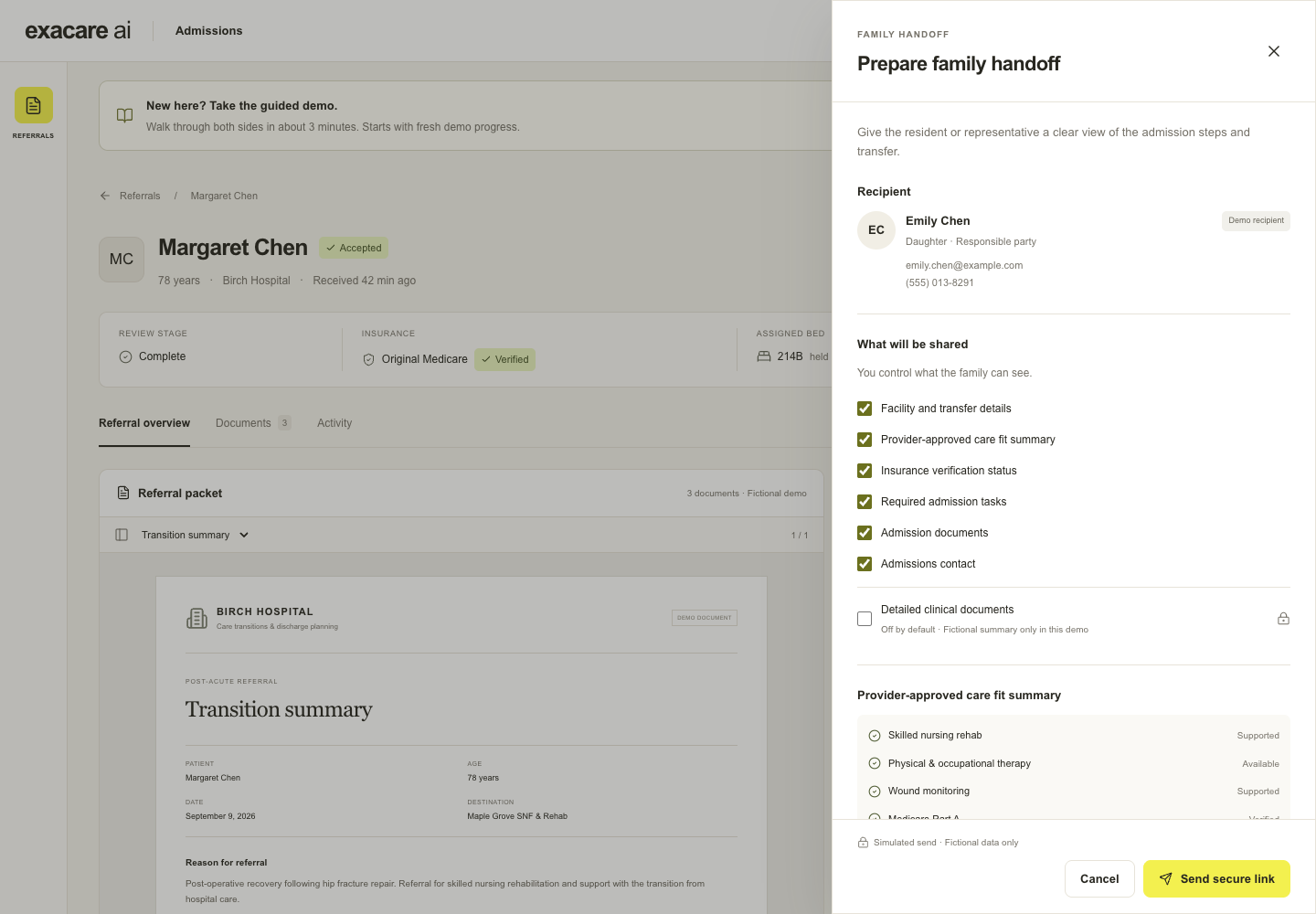
At first, it would have been easy to expose parts of the provider interface to the family. But a provider who uses the product every day and a family going through this for the first time need different things.
I kept the handoff inside the referral workflow, where the provider already has the relevant information. Sharing choices stay visible before anything is sent.
I gave the family view more space, plain language and a smaller set of decisions. They shouldn’t need to understand an admissions system to complete a task.
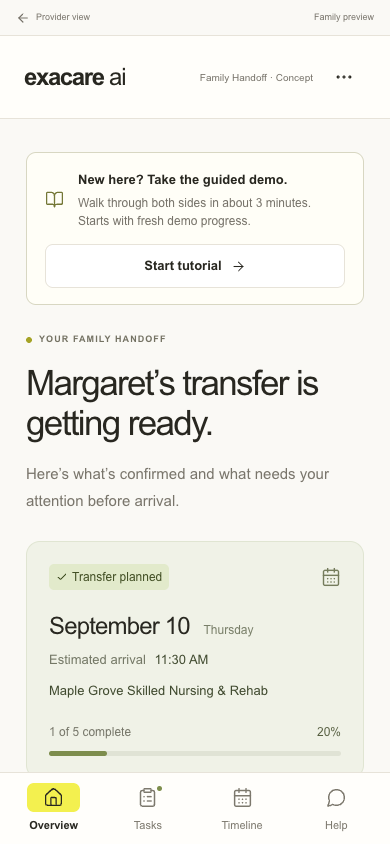
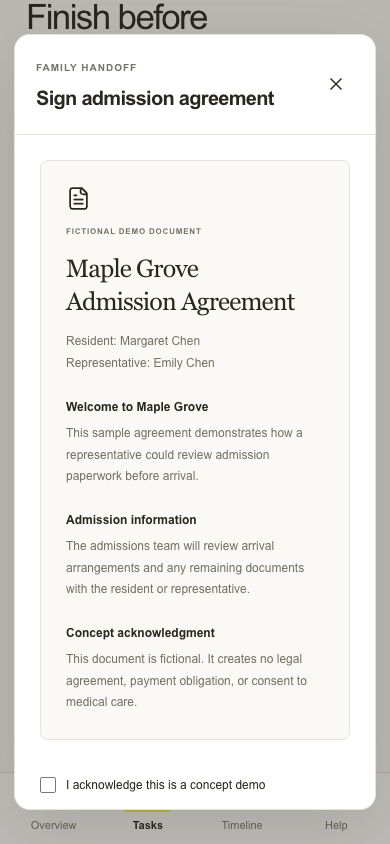
The family side includes a transition overview, next-step tasks, a simulated signing flow, preparation information, a timeline and FAQs. I wanted it to answer the questions around the work, as well as show the work itself.
I’d like to bring the family in earlier, while they’re considering care centres. One might have the equipment their loved one needs; another might be much closer to home. Could Family Handoff help them understand those differences, then keep the next steps in the same place?
Show the available options side by side: relevant services and equipment, distance from home, and which details still need confirming with the care team.
I’d explore a fit score with a clear breakdown of what contributes to it. Families should be able to see why a centre appears suitable, what’s missing, and how their preferences affect the comparison.
That could make this a more complete place to compare options, prepare for admission, and keep track of the handoff. It’s a next-step idea; the current prototype starts after a referral is accepted.
Before building the comparison, I’d work with families and care teams to understand which factors matter, which requirements are essential, and how to keep facility information current. A centre being close to home wouldn’t make up for a care need it can’t meet.
This was my first time using ChatGPT Astra, so part of the project was just trying it out and seeing how far I could take an idea. I ended up with a prototype I could walk through from both sides: preparing the handoff as a provider, then opening it as a family member.
I’m still figuring out what I’d change after real families and care teams try it. My own experience gave me a reason to care about the problem, but there’s a lot about their day-to-day workflow that I haven’t seen yet.
I later got to meet the exacare ai team in person! I showed the prototype to their CEO and other team members, explained why I built it, and attended an after-hours event to hear more about their work. (And I got a free exacare ai cap! Yay.)
That was the most meaningful part for me. Something that started with my family’s experience became a working idea I could put in front of the people working in this space and have a conversation about.
The prototype remains an independent exploration. Presenting it to the team does not establish endorsement, adoption or measured impact on families or providers.